Beyond the Wrapper: Inside Britain's Craft Chocolate Revolution
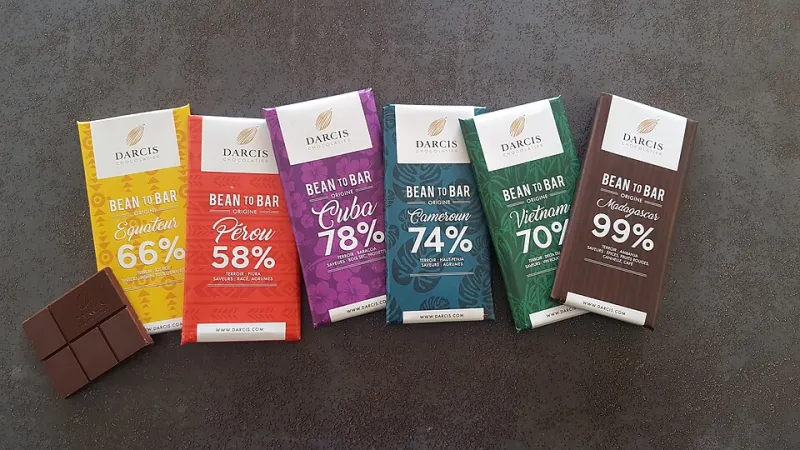
Photo: Wikiesl, CC BY-SA 4.0, via Wikimedia Commons
Open a bar of supermarket chocolate and the experience is largely the same regardless of brand. Sweet, smooth, melting quickly, with a flavour profile that's been engineered for consistency and mass appeal. It's fine. Sometimes it's even good. But it doesn't tell you very much.
Open a bar from one of Britain's growing number of craft chocolate makers and the experience is entirely different. You might get tropical fruit notes, or a long, lingering bitterness that finishes with something almost floral. You might taste dried cherry, or toasted nuts, or a brightness that's reminiscent of citrus peel. And somewhere on the wrapper, there'll be a story — about a specific farm, a particular harvest, a fermentation process that took four days in wooden boxes under a Caribbean sun.
This is bean-to-bar chocolate, and Britain is making some of the best in the world.
What Bean-to-Bar Actually Means
The term gets used fairly loosely, so it's worth being precise. Bean-to-bar means that the maker controls the entire production process from raw cocoa bean to finished chocolate bar. They source their own beans, roast them in-house, crack and winnow them to remove the husks, grind the resulting nibs into a liquid mass called cocoa liquor, and then refine, conche, and temper the chocolate before it's moulded and wrapped.
This is categorically different from what most chocolate companies do. The vast majority of brands — even many that position themselves as premium — buy pre-made chocolate from large industrial suppliers and melt it down, add flavourings, and re-mould it. That's called couverture work, and there's nothing inherently wrong with it. But it means the maker has no control over — or even necessarily knowledge of — what happened to the cocoa before it arrived.
For bean-to-bar makers, that control is everything. "The bean is where the flavour lives," says Dom Ramsey, founder of Dormouse Chocolates in Manchester. "If you don't understand what happened to that bean before it reached you — where it was grown, how it was fermented, how it was dried — you're just guessing at the flavour."
The Flavour Is in the Fermentation
Most people don't realise that chocolate flavour isn't simply a property of the cocoa bean. It's developed through fermentation — a process that happens on the farm, typically in the days immediately after harvest.
Fresh cocoa pods are split open and the beans, still coated in their white, fruity pulp, are piled into wooden boxes or covered in banana leaves and left to ferment for anywhere between three and seven days. During this time, the sugars in the pulp feed a complex microbial process that generates heat and triggers chemical changes inside the bean. This is where the precursors to chocolate flavour are formed.
Get the fermentation right and you'll have beans with extraordinary potential. Get it wrong — ferment for too long, too short, or in poor conditions — and even the finest cocoa variety in the world will produce flat, astringent, or off-flavoured chocolate.
British bean-to-bar makers invest enormous energy in understanding and selecting for good fermentation. Many work directly with farming cooperatives, visiting origin countries, tasting beans from different fermentation batches, and building long-term relationships that allow them to specify exactly what they need.
"It's genuinely collaborative," says Luisa Fernanda, who sources cacao from Colombia and Peru for her East London chocolate studio. "The farmers know what we're looking for. We know what they're capable of producing. Over time, you develop something together that neither of you could achieve alone."
A Map of British Bean-to-Bar
The UK craft chocolate scene has grown substantially over the past decade, and it now spans the country with a diversity of approaches and flavour philosophies.
In Cornwall, Chocolarder has built a reputation for working with rare and unusual cacao varieties, including wild-harvested beans from the Amazon basin. Their bars are minimal in approach — often just two ingredients, cocoa and sugar — which puts extraordinary pressure on the quality of the raw material. The results are some of the most distinctive chocolate made anywhere in Britain.
Up in Edinburgh, Bare Bones Chocolate takes a similarly purist approach, focusing on transparency of sourcing and a clean flavour profile that lets the character of each origin shine through. Their Nicaraguan bar in particular has attracted significant attention in the craft chocolate community internationally.
In the Midlands and across the north of England, a newer wave of makers is experimenting with inclusions and flavour pairings that reflect a distinctly British sensibility — sea salt from Maldon, dried fruit from British orchards, locally foraged botanicals — without losing sight of the quality of the base chocolate.
Why It Matters Beyond the Taste
Craft chocolate is more expensive than the mainstream alternative. There's no getting around that, and it's worth understanding why.
The economics of ethical cocoa sourcing are fundamentally different from those of commodity trading. The global cocoa market is notoriously exploitative — large chocolate companies have historically paid rock-bottom prices that leave farming communities in West Africa and elsewhere in cycles of poverty. Child labour remains a documented problem in industrial cocoa supply chains.
British bean-to-bar makers, almost universally, pay significantly above market rates for their beans — often direct trade prices that go straight to farming families rather than passing through multiple layers of intermediaries. They work with smaller volumes, which means relationships are personal rather than transactional.
When you spend a little more on a craft bar, you're not just paying for better flavour. You're participating in a supply chain that works differently — one that values the knowledge and labour of the people at the start of it.
How to Taste It Properly
If you want to get the most from a quality bean-to-bar chocolate, treat it a little like wine. Break a small piece and let it warm slightly in your hand before tasting. Notice the snap — good tempered chocolate should break cleanly. Then let it melt slowly on your tongue rather than chewing it immediately.
Flavours will develop in waves. The initial impression might be quite different from what emerges as the chocolate warms and opens up. Try bars from different origins side by side and you'll start to notice genuine geographical character — the fruitiness of Madagascan cacao versus the earthier, nuttier profile of Peruvian, versus the bright, almost wine-like quality of some Ecuadorian varieties.
It's a genuinely revelatory experience, and once you've had it, the uniformity of mass-market chocolate becomes harder to ignore.
Britain's craft chocolate makers are doing something remarkable — combining ethical sourcing, deep technical knowledge, and a genuine passion for flavour into bars that can stand alongside the best in the world. They just need more people to find them.
Start looking. The wrappers will tell you where to begin.